Introduction
Sprinkler systems are vital for modern agriculture and landscaping. A well-functioning system ensures water reaches every plant efficiently.
Among the many components, sprinkler couplings play a crucial role. They connect pipes, maintain flow, and reduce leakage. Understanding these couplings can help farmers, landscapers, and engineers optimize irrigation systems.
What Are Sprinkler Couplings?
Sprinkler couplings are connectors joining two or more irrigation pipes. They provide a secure, leak-free connection.
There are several types of couplings:
Slip Couplings – Easy to install; fit over existing pipes.
Threaded Couplings – Screw into pipe ends for a tight connection.
Flexible Couplings – Absorb vibrations and slight pipe misalignments.
Each type serves specific purposes. Slip couplings are popular for maintenance, while threaded couplings ensure long-term stability.

Benefits of Sprinkler Couplings
Sprinkler couplings improve irrigation efficiency in multiple ways:
Leak Prevention: High-quality couplings minimize water loss.
Time Savings: Slip couplings reduce installation time significantly.
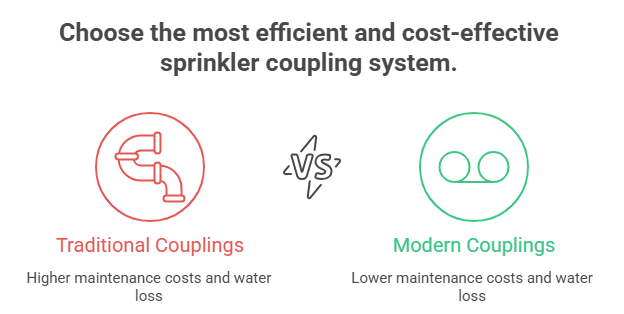
Maintenance Reduction: Fewer breakdowns mean lower maintenance costs.
System Flexibility: Flexible couplings adjust to pipe shifts and expansions.
Materials and Durability
Sprinkler couplings are made from various materials:
PVC: Lightweight, corrosion-resistant, affordable.
Brass: Durable, withstands high pressure, corrosion-resistant.
Stainless Steel: Long-lasting, ideal for harsh environments.
Choosing the right material depends on water pressure, climate, and system requirements. For long-term investment, stainless steel couplings are ideal.
Installation Process
Installing sprinkler couplings is straightforward but requires precision. Here’s a simple guide:
Measure Pipes: Ensure correct pipe lengths.
Cut Pipe Ends: Clean and smooth edges.
Apply Coupling: Slide slip or screw threaded coupling securely.
Check Alignment: Ensure pipes are straight and tight.
Test System: Turn on water and check for leaks.
Proper installation guarantees maximum efficiency and prevents unnecessary maintenance.
Cost vs. Benefit Analysis
Investing in high-quality sprinkler couplings saves money in the long run. Initial costs are offset by:
Reduced water wastage
Lower repair expenses
Faster installation
Longer system life
Common Issues and Solutions
Even with quality couplings, problems may arise. Common issues include:
Leaks: Often due to improper installation or worn seals.
Corrosion: Use stainless steel or brass in high-risk environments.
Misalignment: Flexible couplings prevent damage from shifting pipes.
Regular inspection and proper installation prevent most issues.
demo paragraph
Choosing the Right Coupling
Factors to consider when selecting sprinkler couplings:
Pipe Material and Size: Match coupling type to pipe specifications.
Water Pressure: High-pressure systems need durable couplings.
Environment: Corrosive or outdoor settings require corrosion-resistant materials.
Maintenance Access: Easy-to-remove couplings simplify repairs.
Making informed choices guarantees system efficiency and reduces operational headaches.
Industry Applications
Sprinkler couplings are not limited to farms. They are widely used in:
Agricultural fields
Landscaped parks and gardens
Golf courses
Greenhouses
Sports fields
Fortis Forge provides a range of couplings tailored for these applications.
Sustainability Benefits
Modern sprinkler couplings contribute to sustainable irrigation by:
Minimizing water wastage
Reducing energy used in pumping excess water
Enhancing overall system lifespan
Sustainable systems not only protect the environment but also reduce operational costs.
Conclusion
Sprinkler couplings are a small but vital component of irrigation systems. Choosing the right type, material, and installation method improves efficiency and saves resources.
Fortis Forge offers high-quality sprinkler couplings designed for durability, efficiency, and ease of maintenance. By investing in the right couplings, farmers and landscapers can achieve sustainable, cost-effective irrigation systems.