MS Elbow Socketweld : Complete Guide By Fortis Forge

on

Introduction

In industrial piping, joints matter. A well‑designed elbow ensures smooth flow, structural integrity, and safety. At Fortis Forge, we specialize in MS (mild steel) socket weld elbows used in high‑pressure piping systems

What Is an MS Socket Weld Elbow?

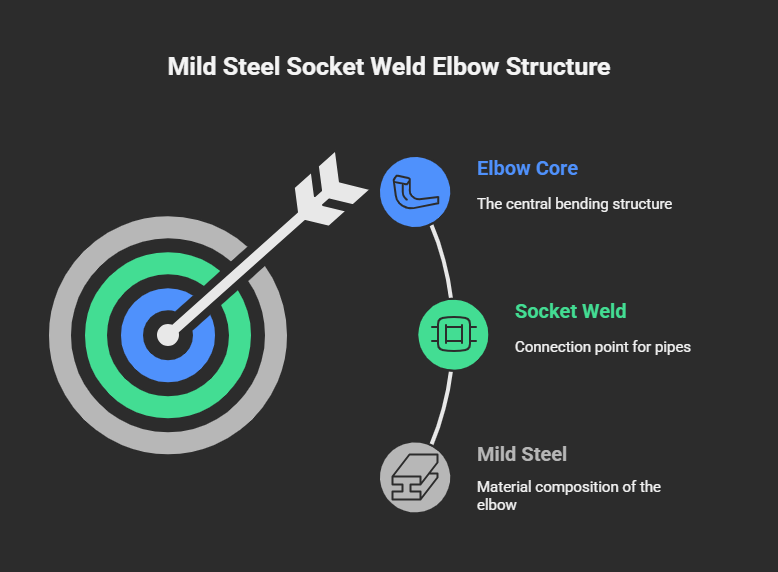
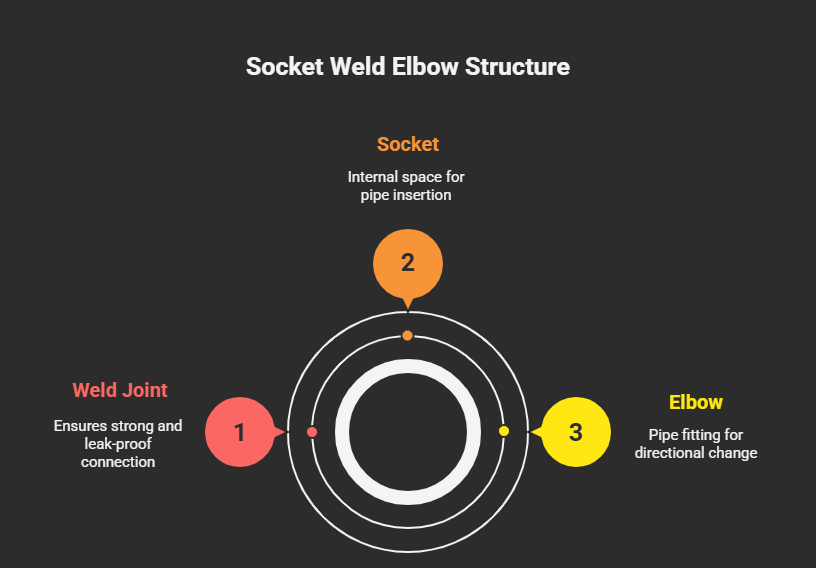
An MS socket weld elbow is a forged mild‑steel pipe fitting. Its ends include a socket—an internal recess—into which the pipe is inserted. Then the joint is fillet‑welded externally to form a sealed connection.

Unlike threaded joints, the weld ensures greater strength and better sealing under pressure. Manufacturers typically follow standards such as ANSI B16.11 for socket weld fittings.

Socket weld elbows come in angles such as 90° or 45°, and in various pressure classes (e.g. 2000 psi, 3000 psi)

Why Choose Socket Weld for Elbows?

2.1 Strength and Leak Resistance

The fillet weld produces a robust joint. This ensures a lower likelihood of leaks, especially in high‑pressure systems.

2.2 Suitable for Small Diameters

Socket welds are ideal for small pipe sizes (often up to 4″ NB). For larger sizes, butt welds often dominate.

2.3 Ease of Alignment

The socket recess helps align the pipe axis easily before welding. This reduces misalignment.

2.4 Cost & Fabrication Time

Welding a fillet joint is simpler than a full penetration butt weld. For smaller pipes, socket welds often save time and cost.

2.5 Limitations & Risks

  • The joint can be susceptible to crevice corrosion at the socket under certain conditions. > “A socket weld is susceptible to crevice corrosion … It only has a single fillet weld.”

  • Socket weld joints may develop fatigue cracks in highly cyclic systems, especially if the weld quality is poor.

  • Because the pipe end stops inside the socket, the inner bore may cause a small step or flow disturbance.

  • Not ideal when full penetration welds are required for critical services (e.g. oxygen, pure gas lines) where butt welds are mandatory.

Why Choose Socket Weld for Elbows?

Design & Dimensioning

3.1 Standard References & Codes

Elbow designs and dimensions follow IS, ANSI, or MSS standards. For instance, socket weld ends often follow IS 4712 (1984) and ANSI B16.11. 

3.2 Dimensional Parameters

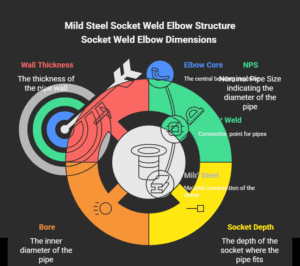
Key dimensions include:

  • Socket depth (the recess depth where the pipe end fits)

  • Bore diameter

  • Wall thickness

  • Elbow centerline radius (long or short radius)

  • Fillet weld leg size

weld elbow dimensions (NPS, socket depth, bore, wall thickness) for standard sizes (e.g. ½” to 4″).
Design & Dimensioning

3.3 Pressure Rating

Socket weld elbows carry ratings like 2000 PSI, 3000 PSI in MS material. 

In forged MS versions, they are tested to high pressures (e.g. 3000 psig hydrotest) per standard practices. 

3.4 Material Selection

Typically, low‑carbon or mild steel (MS) is used for such elbows. The chemistry must meet allowable limits (C, Mn, P, S) for forging quality. 

Fortis Forge can brand or mark the elbow with traceability data (heat number, material certificate, forging stamp).
Manufacturing Process

4.1 Forging & Rough Machining

The initial blank is forged to near shape. Rough machining prepares the socket recess and bore area.

4.2 Finishing & Machining

Finish bore, socket walls, and mating surfaces are machined to final tolerances.

4.3 Welding & Inspection

After the pipe is inserted, a fillet weld encircles the socket. The weld must be free of defects. Non‑destructive tests (Dye Penetrant, Radiography) may apply.

4.4 Quality Checks

Holes, cracks, dimensional checks, weld quality checks, hardness, and surface finish must be inspected.

4.5 Surface Treatment

After manufacture, Fortis Forge may apply coatings (e.g. paint, galvanizing, corrosion protection) per client requirement.


Manufacturing Process socket weld elbow structure

Applications & Use Cases

Socket weld elbows find use in:

  • Chemical processing plants

  • Oil & gas installations

  • Power plants

  • Instrumentation and utility piping

  • Steam, gas, and fluid lines under pressure

Because they perform well in small diameters and high pressure, such elbows are favored in process loops, branch connections, and skid systems.

At Fortis Forge, we emphasize high reliability in critical systems. We deliver components with certification, material traceability, and manufacturing controls.

Best Practices & Installation Tips

  • Use clean pipe ends. Deburr and clean before insertion.

  • Ensure correct insertion depth (pipe end should bottom in socket).

  • Use backing strips or run‑off tabs to ensure good fillet weld quality.

  • Maintain weld leg size per specification.

  • Avoid misalignment; small angular deviation may cause stress concentration.

  • After welding, inspect and remove slag, scale, or defects.

  • For cyclic or vibration‑prone systems, consider periodic inspection.

  • Always follow applicable codes and standards (ASME, MSS, IS).

Limitations & When Not to Use

Even though socket weld elbows are useful, there are cases to prefer alternatives:

  • Large pipe diameters (where butt weld is more effective)

  • Services demanding full penetration welds or seamless joints

  • Where internal smoothing is critical (butt weld gives a smoother bore)

  • In highly corrosive environments where socket recess may trap corrosive media

  • High fatigue stress applications with frequent cycles

Understanding these limitations helps in making the right choice.

Case Study (Hypothetical / Fortis Forge Scenario)

Project: A chemical plant requested MS socket weld elbows for process piping from ½” to 3″, class 3000 psig.

Challenges: Tight tolerances, cyclic temperature swings, client required full traceability.

Solution by Fortis Forge:

  • We forged blanks, machined sockets with ±0.1 mm tolerance.

  • Provided heat number stamping and mill test certificates.

  • Applied corrosion protection.

  • Supplied a dimension chart and data sheet.

  • Delivered zero leak joints during hydro test.

Outcome: The plant ran reliably for over 5 years with minimal maintenance.

Case Study (Hypothetical / Fortis Forge Scenario)

Conclusion

MS Elbow Socketweld fittings offer strong, leak-proof, and durable connections for high-pressure piping systems. They are easy to install, reliable, and cost-effective, making them an ideal choice for industries that require safe and efficient fluid flow.

Send message

Forge a Connection with Us

Let’s start building something strong together. Reach out to Fortis Forge for reliable solutions in forged fittings, buttweld fittings, and carbon steel flanges. Whether it’s a custom requirement or a bulk order, our team is ready to support your industrial needs.

Hyderabad

Powered by Fortis Forge. Designed & Developed by Skytech SEO Solutions